
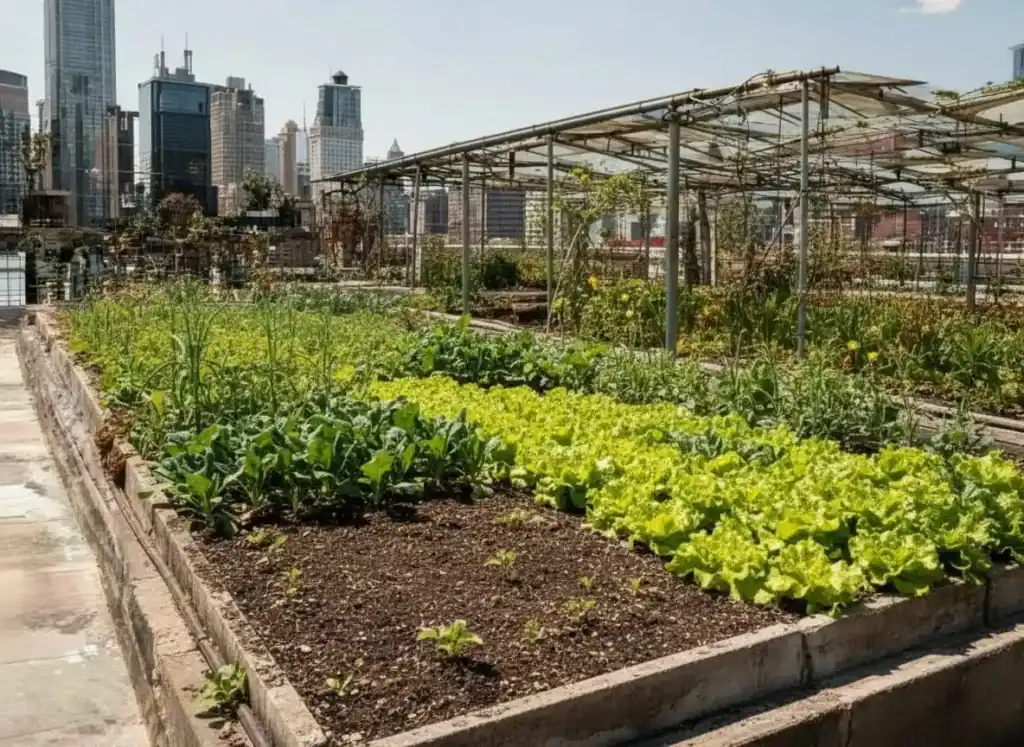
Winter-Proofing Food Justice: Why Brooklyn’s Community Gardens Need Greenhouses
At Tropics International Ltd, we believe that access to fresh, healthy food should not be seasonal. Guided by the philosophy of Ubuntu—”I am because we are”—we recognize that when our community gardens go dormant, our most vulnerable neighbors lose a vital lifeline. To move forward sustainably in an urban environment like New York City, we must transform our gardens from seasonal hobbies into year-round engines of food sovereignty through the power of greenhouses.
1. The Core Insights
The “Dormancy Trap” (via Urban Design Lab & NYS Dept. of Agriculture)
New York City is home to over 1,000 community gardens, yet most operate with a significant “productivity gap.” Without climate-controlled structures, these spaces are essentially abandoned during the winter months, left at the mercy of the elements and covered in snow. This dormancy limits the range of food that can be grown—largely to short-season summer crops—and forces families back into a total reliance on expensive, store-bought produce during the coldest months.
The Greenhouse Solution (via Wikifarmer & USDA Climate Hubs)
Greenhouses and Controlled Environment Agriculture (CEA) offer a sustainable pathway to bridge this gap. By creating a microclimate, greenhouses allow for the production of high-value, nutrient-dense herbs, vegetables, and fruits 365 days a year. Modern systems like hydroponics and aeroponics can be integrated into these structures to provide significantly higher yields per unit area, making even the smallest Brooklyn lot a powerhouse of local food production.
2. The Tropics International Lens
At Tropics International Ltd, our role is to act as the catalyst that turns community needs into reality. We see the untapped potential in Brooklyn’s snowy, abandoned garden plots as a missed opportunity to combat the “nexus” of poverty and food insecurity.
When a community garden is equipped with a greenhouse, it ceases to be just a summer patch of green; it becomes a permanent resource for the urban poor. In a city where store prices are among the highest in the world, providing free, clean, and organic food year-round is a direct act of economic empowerment. By “winter-proofing” our gardens, we aren’t just growing food; we are boosting a sense of community, improving livelihoods, and building the resilience needed to face a changing climate.
True to the spirit of Ubuntu, a greenhouse is a shared responsibility that yields a shared benefit. It provides a warm, productive space for elders to gather and youth to learn even in February, ensuring that the “path forward” is community-led and sustainably integrated into the fabric of New York City.
3. Actionable Advice
To fully harness Brooklyn’s agricultural potential, we advocate for the following:
Infrastructure Overhaul: We must transition from “seasonal plots” to “year-round hubs” by installing greenhouses in every community garden, particularly in underserved neighborhoods.
Adoption of CEA Technology: Integrating vertical farming and hydroponics within these greenhouses will allow us to maximize yield in small urban spaces without the need for traditional soil-based limitations.
Policy Advocacy for “Green Zones”: We urge the city to streamline the permitting process for permanent agricultural structures like greenhouses, treating them as essential infrastructure for food justice rather than temporary garden ornaments.
4. The Sources
Urban Design Lab (Columbia University): The Potential for Urban Agriculture in NYC
Wikifarmer: Urban Farming with Rooftop Greenhouses
NYS Department of Agriculture: Community Gardens and Urban Agriculture
USDA Climate Hubs: Urban Agriculture and Climate Resilience
NYC Food Policy Center: 11 NYC Urban Agriculture Organizations to Follow
“When communities grow together, everyone benefits.” Help us build a year-round sustainable future for Brooklyn.